Service Pages vs. One General Services Page: Which Website Structure Gets Small Businesses More Leads?
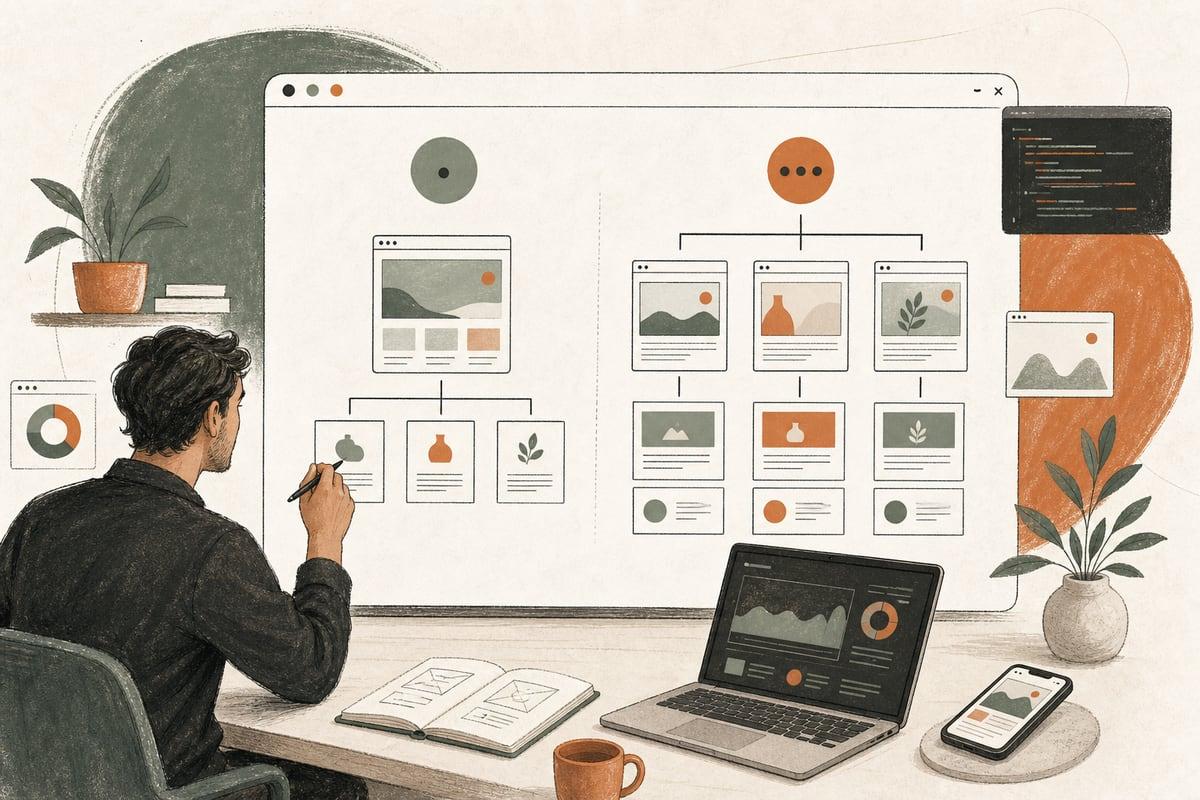
If you want more qualified leads, most small businesses do better with separate service pages instead of one broad “Services” page. The right structure makes it easier for Google, AI answer engines, and real visitors to understand exactly what you offer and when to contact you.
Why this matters more than most business owners realize
A lot of small-business websites have a homepage, an about page, a contact page, and one services page with a long list of everything they do. That seems tidy, but it often creates two problems:
- Search engines can’t clearly match each service to specific searches.
- Visitors have to work too hard to figure out whether you solve their exact problem.
If someone searches for “water heater repair,” “probate lawyer,” “dental implants,” or “commercial roof coating,” they want a page that speaks directly to that need. A generic services page can be too broad to rank well and too vague to convert well.
This does not mean every business needs 25 thin pages. It means your website structure should match how your customers search and how they make buying decisions.
The short answer: when separate service pages are better
You should usually create separate service pages if:
- You offer multiple distinct services
- Customers search for those services by name
- The services have different benefits, pricing considerations, timelines, or FAQs
- You serve different industries or case types
- You want better SEO for service-specific searches
- Your current site gets traffic, but it is not qualified traffic
A single services page may be enough if:
- You offer one core service with only minor variations
- Your sales happen mostly through referrals, not search
- Your website is very small and you need a simple starter structure
- Your services are so tightly connected that splitting them would create repetitive, weak pages
What separate service pages do better
1. They help you rank for the searches that actually matter
Google does not just rank websites. It ranks pages.
If you want to show up for specific searches, you usually need a page specifically about that service. For example:
- A med spa may need separate pages for Botox, fillers, laser hair removal, and microneedling
- A law firm may need pages for personal injury, wrongful death, car accidents, and slip-and-fall cases
- A contractor may need pages for kitchen remodeling, bathroom remodeling, ADUs, and room additions
- An IT company may need pages for managed IT, cybersecurity, cloud migration, and compliance support
Each page gives you a better opportunity to align with:
- Search intent
- Relevant keywords
- Location modifiers
- FAQs people actually ask
- Calls to action tied to that service
2. They increase conversion because they reduce doubt
Most visitors are asking one simple question: “Is this business right for my exact need?”
A dedicated service page lets you answer that clearly. You can explain:
- What the service is
- Who it is for
- Common problems it solves
- What the process looks like
- What makes your approach different
- What the next step should be
That is much stronger than a bullet list on a general services page.
3. They work better for AI answer engines
AI tools like ChatGPT, Gemini, and Perplexity often favor content that is specific, well-structured, and easy to summarize. A focused service page is easier for these systems to understand than one page covering 12 unrelated offers.
If your page clearly explains a service, the ideal customer, your service area, and the next step, it has a better chance of being used as a source or cited in AI-generated answers.
When one general services page still makes sense
There are cases where one page is the smarter move.
Use a single services page if your business is still early-stage and:
- You need to launch quickly
- You only have one or two closely related offers
- You do not yet have enough content to make separate pages useful
- You would otherwise publish multiple pages with almost identical text
Example: a solo consultant with one main offer and two small add-ons may not need a large service-page structure yet.
The key is not page count. The key is clarity.
A practical way to decide
Use this checklist. If you answer “yes” to 4 or more, separate pages are probably worth it.
Separate service pages checklist
- Do customers ask about these services separately?
- Do people search for these services using different terms?
- Does each service solve a different problem?
- Does each service have different pricing or scope?
- Would each service benefit from its own testimonials, examples, or FAQs?
- Do you want to run ads or SEO campaigns to specific services?
- Can you write at least a few strong paragraphs of unique content for each one?
If most answers are “no,” start with one well-built services page and improve later.
The biggest mistake: making separate pages that are too thin
Creating separate pages is not automatically better. Many websites hurt themselves by publishing weak pages that say almost nothing.
Bad service pages usually have:
- 100 to 200 words of generic copy
- Repeated text with only the service name changed
- No local relevance
- No clear CTA
- No proof, FAQs, or explanation of process
That kind of page often does not rank and does not convert.
A good service page should feel like a useful landing page, not filler.
What to put on a high-converting service page
If you decide to split services into separate pages, each page should include:
Core page elements
- A clear headline naming the service
- A short intro that says who it is for and what problem it solves
- A list of common situations or symptoms
- A simple explanation of your process
- Key benefits or outcomes
- Service area details if local SEO matters
- FAQs for that specific service
- A strong call to action
Trust elements
- Reviews or testimonials relevant to that service
- Photos, examples, or case snapshots if appropriate
- Licenses, certifications, or years of experience where relevant
- Clear expectations about response time or next steps
SEO and AI clarity elements
- Descriptive page title and meta description
- Clean heading structure
- Specific language, not vague marketing phrases
- Internal links to related services and contact pages
- Clear mention of city/region when relevant
Recommended page structure for most small businesses
For many local businesses and professional firms, this structure works well:
- Homepage
- About
- Main Services overview page
- Individual service pages for core revenue services
- Service area pages only if they are truly useful and unique
- Contact / booking page
That means you do not have to choose between one services page and many service pages. Often the best setup is both:
- A main services overview page for browsing
- Individual pages for the services that drive search and leads
This gives visitors a simple overview while still giving each important service its own sales and SEO page.
How to prioritize if you cannot build everything at once
You do not need to create 10 pages in one week. Start with the pages most likely to produce revenue.
Prioritization steps
- List all your services
- Circle the ones with the highest profit or best close rate
- Mark the services customers most often search for by name
- Identify which services need more explanation before people contact you
- Build pages for the top 3 to 5 first
This approach is better than spreading effort evenly across low-value pages.
Signs your current structure is holding you back
You may need separate service pages if:
- People keep calling for the wrong type of work
- You rank for your brand name but not for core services
- Your ads all go to one general services page
- Visitors land on your site but do not convert
- Your competitors have much more focused service content
- Your team keeps answering the same basic pre-sale questions manually
In some cases, adding better service pages also creates a foundation for AI automation. A chatbot or AI receptionist performs better when your website clearly explains each service, who it is for, and what the next step should be.
The ROI view: this is not just an SEO decision
Better service-page structure can improve more than rankings.
It can help:
- Attract better-fit leads
- Reduce confusion before the first call
- Increase form completion rates
- Support ad landing pages
- Improve AI chatbot responses
- Make your follow-up conversations shorter and more productive
That is why service-page structure is really a sales tool, not just a content decision.
Bottom line
If your business offers several distinct services, separate service pages usually give you a better shot at both rankings and conversions. But only create them if you can make each page genuinely useful, specific, and focused on the customer’s real problem.
A simple website can work. A vague website usually does not.
Frequently asked questions
Do I need a separate page for every single service?
No. Focus first on your main revenue-driving or frequently searched services. Small variations can often stay on one broader page.
Will separate service pages help local SEO?
Usually, yes, if the pages are specific, useful, and tied to real search intent. Thin duplicate pages will not help much.
Should I keep a main services page too?
In most cases, yes. A main overview page helps visitors browse, while dedicated service pages help with search and conversions.
How many service pages should a small business start with?
Often 3 to 5 strong pages is a smart starting point. Quality matters more than publishing a large number of weak pages.
Can this improve paid ads too?
Yes. Dedicated service pages usually make better landing pages than a general services page because they match the visitor’s intent more closely.
If you want help deciding how your website should be structured to bring in more qualified leads, book a free consultation: https://webmasterandmore.com/consultation
Free 60-second checkup
How healthy is your own website?
Paste your address, get an instant health check — speed, mobile experience, Google visibility, trust, and security. No email required.
Check my website freeOr just take one tip a month
A short monthly email with one practical way to make your website work harder. No spam, unsubscribe anytime.