How a Headless Website Makes Your Business Faster and More Secure
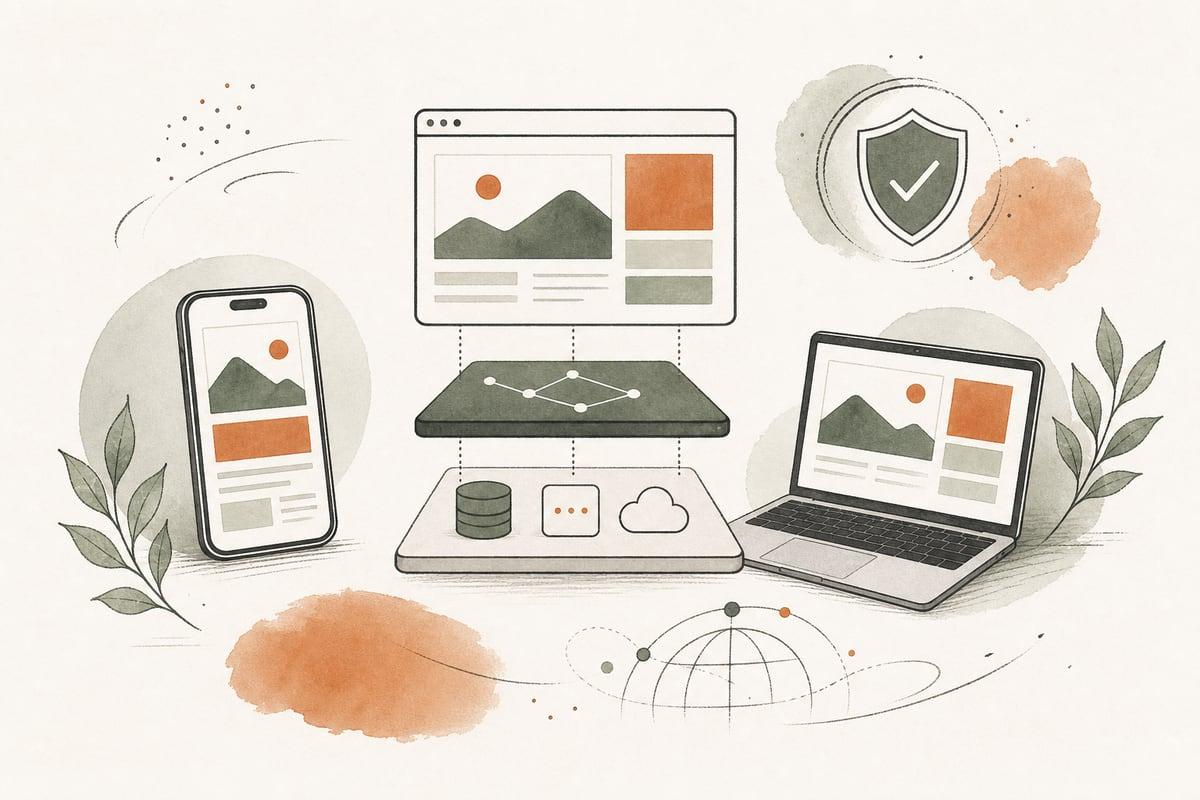
A headless website can make your business website faster, more secure, and easier to scale because the front end is separated from the content management system. That setup reduces common bottlenecks, limits some security risks, and gives developers more freedom to build a better customer experience.
What is a headless website?
A headless website is a site where the content management system (CMS) and the front-end website are split into two separate parts.
In a traditional website, your CMS and your front end are tightly connected. For example, with a standard WordPress setup, the same system manages your content, themes, plugins, and page output.
With a headless setup:
- The CMS stores and manages content
- An API delivers that content
- A separate front end displays it to visitors
That front end is often built with modern frameworks like Next.js, which are known for speed and flexibility.
For a business owner, the technical structure matters because it affects things your customers actually notice:
- How quickly pages load
- How smooth the site feels on mobile
- How reliable the site is during traffic spikes
- How easy it is to connect your website to booking tools, CRMs, and AI features
- How exposed the site is to common attacks
The main headless website benefits for business
If you are researching headless website benefits for business, these are the advantages that usually matter most.
1. Faster page speed can improve user experience and conversions
Speed is one of the biggest reasons companies move to headless.
A headless front end can be built to serve pages much more efficiently than a typical theme-heavy website. Instead of loading a large stack of plugins, theme files, and database queries on every visit, many headless websites deliver lightweight, optimized pages.
That can help with:
- Faster initial page loads
- Better mobile performance
- Lower bounce rates
- A smoother browsing experience
- Better Core Web Vitals potential
For a small business, speed is not just a technical metric. It affects real customer behavior.
If someone visits your law firm, clinic, contractor, or service business website and it loads slowly, they may leave before they ever call or fill out a form. A faster site gives you a better chance to keep that visitor engaged.
Practical speed advantages of headless builds
- Cleaner codebase than many off-the-shelf themes
- Better image optimization workflows
- More control over caching and content delivery networks
- Fewer render-blocking assets
- Easier performance tuning page by page
That said, speed is not automatic. A poorly built headless site can still be slow. The benefit comes from a well-architected setup, not from the word “headless” alone.
2. Better security through reduced exposure
A traditional CMS-driven website often exposes more of its moving parts to the public web. That can include login paths, plugins, theme vulnerabilities, and common attack surfaces.
A headless website can improve security because the public-facing site is separated from the CMS.
In many cases, that means:
- The CMS is hidden behind tighter access controls
- The front end exposes less sensitive infrastructure
- There are fewer plugin-related vulnerabilities on the public site
- Attackers have a smaller surface to target
This does not mean a headless website is unhackable. No website is.
But it can reduce risk, especially when paired with:
- Managed hosting
- Web application firewall protection
- Strong user permissions
- Regular updates and monitoring
- Secure API configuration
For businesses that handle lead forms, appointment requests, or client inquiries, stronger security is more than an IT issue. It protects your reputation and reduces downtime risk.
3. More flexibility for custom features and integrations
Headless websites are often a strong fit when your business needs more than a brochure site.
Because the front end is decoupled, developers have more freedom to build custom experiences without fighting the limits of a prebuilt theme.
This can be useful if you want to connect your website with:
- CRM systems
- Online scheduling tools
- Membership portals
- E-commerce systems
- Search tools
- AI chatbots
- AI phone receptionist workflows
- Internal business software
For example, a clinic may want a fast marketing site connected to booking software. A law firm may want content pulled into multiple landing pages. A contractor may want location pages, quote request flows, and CRM syncing. A nonprofit may want donation systems and campaign pages with strong performance.
Headless architecture can make those kinds of systems easier to design cleanly.
4. Easier scaling as your business grows
As your business grows, your website often needs to do more.
That might include:
- Publishing more content
- Supporting more traffic
- Adding landing pages for new services
- Expanding to multiple locations
- Connecting more marketing tools
- Serving content across web, mobile, kiosks, or apps
A headless CMS structure can support this growth more cleanly because content is managed centrally and distributed through APIs.
That means your content can potentially be reused across multiple channels without rebuilding everything from scratch.
If your long-term plan includes major content marketing, multi-location SEO, or custom digital tools, headless can give you more room to grow without replatforming as quickly.
5. Strong SEO potential when built correctly
A common question is whether headless websites are good for SEO.
The short answer: yes, if they are built properly.
Modern headless frameworks like Next.js can support important SEO needs such as:
- Fast page loads
- Server-side rendering or static generation
- Clean URLs
- Custom metadata
- Structured data
- Strong internal linking
- Good mobile performance
Those are all important for search visibility.
The catch is that SEO in headless setups must be planned intentionally. A poorly configured build can create issues with rendering, metadata, indexing, or redirects.
So while headless can be excellent for SEO, it is not a shortcut. It needs the right technical setup from the start.
When a headless website makes the most sense
Headless is usually a good fit when your business needs one or more of the following:
- You want a noticeably faster website
- Your current WordPress site feels bloated or fragile
- Security is a major concern
- You need custom integrations with business tools
- You want a highly customized user experience
- Your site supports lead generation at a high level
- You plan to scale content or features over time
Businesses that often benefit include:
- Medical and dental practices
- Law firms
- Contractors and home service companies
- Multi-location businesses
- Nonprofits with active campaigns
- Professional service firms
- Brands investing in SEO and content marketing
When headless may not be the best choice
Headless is not always the right answer.
For some small businesses, a well-built traditional WordPress site is more practical and cost-effective.
Headless may not be the best fit if:
- Your website is very simple and rarely changes
- You have a limited budget
- You rely heavily on drag-and-drop editing across many pages
- You do not need custom functionality or advanced integrations
- Your current site can be improved significantly with better hosting, cleanup, and optimization
Honest trade-offs to consider
Before choosing headless, understand the trade-offs:
- Development is usually more specialized
- Initial build costs can be higher
- Some editing workflows may need training
- Maintenance involves both CMS and front-end systems
- Not every plugin-based feature translates directly
In other words, headless is powerful, but it is not automatically simpler.
A simple checklist: should your business consider headless?
You should seriously consider a headless website if you answer yes to several of these:
- Is website speed hurting user experience or SEO?
- Do you need stronger security than a typical plugin-heavy site offers?
- Does your site need custom integrations with outside tools?
- Are you planning major growth in content, locations, or services?
- Do you want a more custom design than a standard theme can deliver?
- Is your website an important lead-generation asset for the business?
If most answers are no, a traditional site may still be the better ROI.
How to evaluate the ROI of going headless
Do not evaluate headless on technology alone. Evaluate it based on business outcomes.
Ask questions like:
- Will a faster site help us get more calls, forms, or bookings?
- Will stronger security reduce business risk?
- Will a better user experience improve conversion rates?
- Will custom integrations save staff time?
- Will a more scalable platform prevent future rebuild costs?
If the answer is yes in meaningful ways, the investment may be worth it.
The best decision is not the most advanced option. It is the option that gives your business the best return.
Final thoughts
The biggest headless website benefits for business are faster performance, stronger security, better flexibility, and more room to grow. For the right company, that can translate into a better customer experience and a website that supports real business goals instead of holding them back.
But headless is not a magic fix. It works best when your business actually needs the speed, customization, and scalability it provides.
If you are not sure whether a headless build or a traditional WordPress site makes more sense, a practical review of your current website, goals, and budget is the right place to start.
Frequently asked questions
Is a headless website better than WordPress?
Not always. A headless website can be faster, more secure, and more flexible, but a traditional WordPress site can be the better value for simpler business needs.
Is headless good for small businesses?
Yes, especially for small businesses that depend on their website for leads, need custom integrations, or want better speed and scalability.
Are headless websites more secure?
They can be more secure because the public-facing site is separated from the CMS, reducing some common attack surfaces. But they still need proper hosting, updates, and monitoring.
Does headless help SEO?
Yes, if built correctly. Headless sites can perform very well for SEO because they can be fast, mobile-friendly, and technically clean.
How do I know if headless is worth the cost?
Look at business impact: speed, conversion improvement, security needs, integration needs, and long-term growth. If those matter strongly, headless may be worth the investment.
If you want help deciding whether a headless website is the right move for your business, book a free consultation at https://webmasterandmore.com/consultation.
Free 60-second checkup
How healthy is your own website?
Paste your address, get an instant health check — speed, mobile experience, Google visibility, trust, and security. No email required.
Check my website freeOr just take one tip a month
A short monthly email with one practical way to make your website work harder. No spam, unsubscribe anytime.